Back to the pictures
December 16, 2011 § 2 Comments
The time has come to a) examine breasts, and b) return to art.
If you have been following me on twitter, you may know that I have been consulting surgeons about having a bilateral mastectomy, followed by reconstruction. This is because my breast cancer is the result of me being a carrier of the inherited BRACA1 gene. The geneticist from Great Ormond Street tells me that having this gene meant that I had an eighty percent chance of developing breast cancer over the course of my life – yes, bloody hell, eighty percent. I still have a fifty percent chance of developing a brand new tumor. Not being that keen to repeat the experience, I am opting to have both breasts removed and replaced either by implants or tissue from my stomach.
Not surprisingly therefore, breasts have been on my mind, so to speak. Here are some thoughts, illustrated by work I have shamelessly raided from the Tate’s 20th Century collection. (Apologies to them.)
1. Vanessa Bell, Nude circa 1922-3 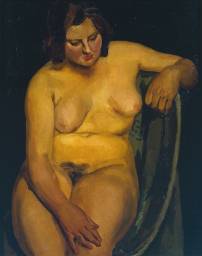
I like this because the model looks like a normal woman (i.e. me). She’s also a bit lob-sided, which apparently is usual. One of the problems for a surgeon undertaking reconstruction on a single breast is matching its size to the remaining one. My file at the hospital is full of sketches and measurements, although having both done at once makes this mismatching less of an issue. I also sympathise with the general fed-up look of this woman.
2. John Currin, The Wizard circa 1994

I’m not entirely sure what is going on here, but it reminded me of my many examinations (and yes, I usually look like the lady here). Surgeons do a lot of looking and weighing up. And, while my science friends will reject this, they are something like modern-day wizards. The options I am being given are pretty damn amazing.
3. Mark Gertler, Queen of Sheba 1922
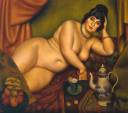
One of the options for reconstruction is to take tissue from the stomach and reallocate it. This would be an eleven hour operation, involving three consultants. Blimey. You have to have enough of a stomach to do this, so for once the larger, pie-eating woman comes into her own. The Queen of Sheba would have been a good candidate.
4. Hans Bellmer, The Doll 1936/1965
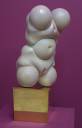
The issue with using the stomach is whether there is enough there to make breasts of “an appropriate size”, appropriate I assume to the particular patient. You don’t want to wake up after eleven hours of surgery and be disappointed, I suppose. Here, we see something of an inappropriate size.
4. Rineke Dijkstra, Julie, Den Haag, Netherlands, February 29 1994
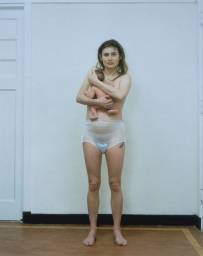
The point of breasts, 1: for the baby.
4. Eric Gill, Ibi Dabo Tibi 1925
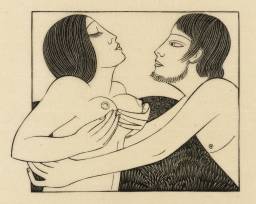
The point of breasts, 2: self-evident. (Plus, I have a soft spot for Eric Gill, only because a Walter Shewring – no relation – edited his letters.)
5. Eric Gill, Skaters 1926
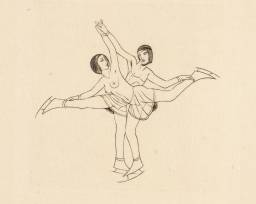
The point of breasts, 3: admittedly less common, but nude ice skating.
6. David Bomberg, Lilian 1932

This is a portrait of Bomberg’s wife, Lilian. The Tate says, “Lilian remembered that she sat with a black satin dressing-gown around her shoulders and arms, because she was shy of posing completely nude.” I like this painting because it reminds me that there was a time when the world and his wife had not measured, poked, photographed and sketched my chest, when I did care who saw and who didn’t. I like her modesty and the way the artist keeps something back from the viewer. This is how it was and maybe how it will be again.
Professor Mary Collins and how I am messing with her life’s work for cheap, blogging gain
December 6, 2011 § 2 Comments
Last week, to celebrate World Aids Day, I went to a lecture given by Professor Mary Collins. Mary, aside from being my friend, is Professor of Immunology and Dean of Life Sciences at University College London and her lecture was titled, “From pathogen to ally: engineering viruses to treat disease.” I didn’t understand much of it, but here’s what I think Mary and her team are doing.
The HIV virus is very good at making its way through the body to attack the body’s immune system via its T-cells. What Mary is doing is turning this on its head, genetically engineer the HIV virus so that it can carry good stuff into cells where nasty stuff is happening. At the moment, the practical uses for this are limited, although a team in Paris have used a modified HIV virus to treat children with a disease called adrenoleukodystrophy, a severe hereditary condition in which the nerves gradually lose function leading to increased mental and physical disability – it’s the disease featured in the film Lorenzo’s Oil. What Mary and her colleagues hope to do in increase the uses of the HIV virus to improve vaccinations for a range of other diseases from Parkinson’s to influenza.

Tactless nurse shows man with polio that, thanks to vaccines, for everyone else, polio is over.
Now I may have got the science wrong (and you can read Mary in her own words here). This is difficult stuff for the lay person: the words are unfamiliar, the diagrams make only minimal sense and this is before we even contemplate what’s going on here. A virus that has killed 24 million people since 1981, that is still reducing life expectancy for people in countries like Botswana by at least 20 years, is being manipulated to offer other people will all kinds of horrible conditions the hope of a cure. How amazing is that?

Tricky science diagram
At the same time, Siddhartha Mukherjee’s book, The Emperor of All Maladies, about the history of cancer, won the Guardian First Book Award. I can’t quite bring myself to read this at the moment, but it does sound good, covering everything from 19th century mastectomies, performed without anaesthetic or penicillin, to the development of chemotherapy from observations of the effects of mustard gas during World War I.
In an interview with the Guardian, Mr Mukherjee answers the question; can a positive attitude cure cancer?
“No, I think it’s not true. It’s not true. In a spiritual sense, a positive attitude may help you get through chemotherapy and surgery and radiation and what have you. But a positive mental attitude does not cure cancer – any more than a negative mental attitude causes cancer.”
I like this. I don’t believe that my life is dependent on whether I think good thoughts or not, which is just as well as my thoughts are not always very positive. It’s more comfortable if you can think positively but who can do that every day? I would much rather believe that my fate is in the hands of people like Mary, who work away, year after year, making progress, inch by inch.

Coincidently, on the way to Mary’s lecture, I was listening to a downloaded edition of In Our Time about Miracles. One of the contributors made the point that miracles may well just be phenomenon that we just don’t understand yet. His example: if you have no knowledge of optics, a rainbow would seem like a miracle.
Modern medicine is not a miracle – someone understands it, even if that someone isn’t really me. All I think is how grateful I am that people like Mary and her colleagues and students are wearing their white coats and doing things with test tubes and microscopes and making this stuff happen.
Getting Lost with Jacky Charles
November 23, 2011 § 2 Comments
One of my many ideas that have come to nothing was to write a novel about a maze. My hero, Jacky Charles, worked as a groundsman for a big estate, a bit like Lower Loxley in The Archers. He had some deep, dark secret and then a woman turned up from his earlier life who knew that deep, dark secret. In the meantime, she had become a born again Christian. She blackmailed Jacky Charles into building a maze in the grounds of the estate, as a kind of homage to the great medieval cathedral labyrinths. It would have ended with Jacky going mad and setting fire to himself in the centre of the maze.
As a result of this nonsense, I have a slight interest in mazes and labyrinths. As you may know, there is a difference. A maze gives you a choice of pathways. Go this way or that. In a labyrinth, on the other hand, there is only one, unambiguous path. The walker follows it to the centre and then out again. There are no decisions to be made.
I was reminded about all this today, walking passed St Martin in the Fields. In the courtyard, people were chalking a labyrinth onto the ground. When it was ready, walkers started following its path, only really, really slowly. It was part of an event called Just this Day, about being silent.

Walking slowly
I’m not particularly in favour of silence. I know many wise voices speak up on behalf of quiet reflection, but stepping out of the usual to celebrate silence and stillness – mmm, I’m not sure. I probably should be doing that more, thinking about life, the future, things in general but I’m not, not really. Partly, it’s because my brain feels like it’s wrapped in clingfilm, but partly it seems like tempting fate to even begin that kind of contemplation. Hence, I find myself watching reruns of Desperate Housewives and embarking on the box set of Murder One instead of thinking how I can carve a better, more worthy life from this experience. To be honest, just being here seems quite ambitious.
So here’s the rather lame, bringing this all together finale.
It’s a bit like I’m in a labyrinth right now – one path, get to the middle, get to the end. There aren’t a lot of choices really. Which is why I’ve always preferred mazes. More human, more like I can make my own mistakes rather than living by some preordained genetic slight of hand.
That didn’t really work, did it? Ah well. Here’s a nice picture of a maze.
My favourite maze, at Chatsworth (and a hello to you Derbyshire/Sheffield folk). It comes with a cup of tea and a nice slice of cake.
We do like a day out
November 21, 2011 § 3 Comments
A couple of people have asked me what it’s like to have chemotherapy. They are not talking about the side effects of which I’ve discussed/droned on about previously in this blog and am likely to do so again. Instead, they are asking about the process so here’s a little “day in the life of” for chemo days. Be warned: it’s a bit dull and there isn’t much art.
I am having six doses over eighteen weeks, so once every three weeks. My fourth session was last Friday. The key is the blood count. Either the day before or that morning, I have a blood test to check that my white blood cells have sufficiently recovered from the last dose. There is concern that I’m not left too vulnerable to infection, and once my treatment had to be delayed until said blood cells had reproduced sufficiently to protect me from unnamed enemies.
Assuming all is well, I then wait around while the drugs are prepared. This takes an hour or so because, understandable, the NHS doesn’t want to waste money on drugs that are not going to be used. If I’m with my friend, we usually take a spin round the neighbourhood while we wait: have a coffee, buy M&S groceries for the St Paul’s protest, see if there’s anything happening at the Central Criminal Court. Once we visited the Postman’s Park, and looked at the plaques to commemorate people who died saving others. Here are a couple.
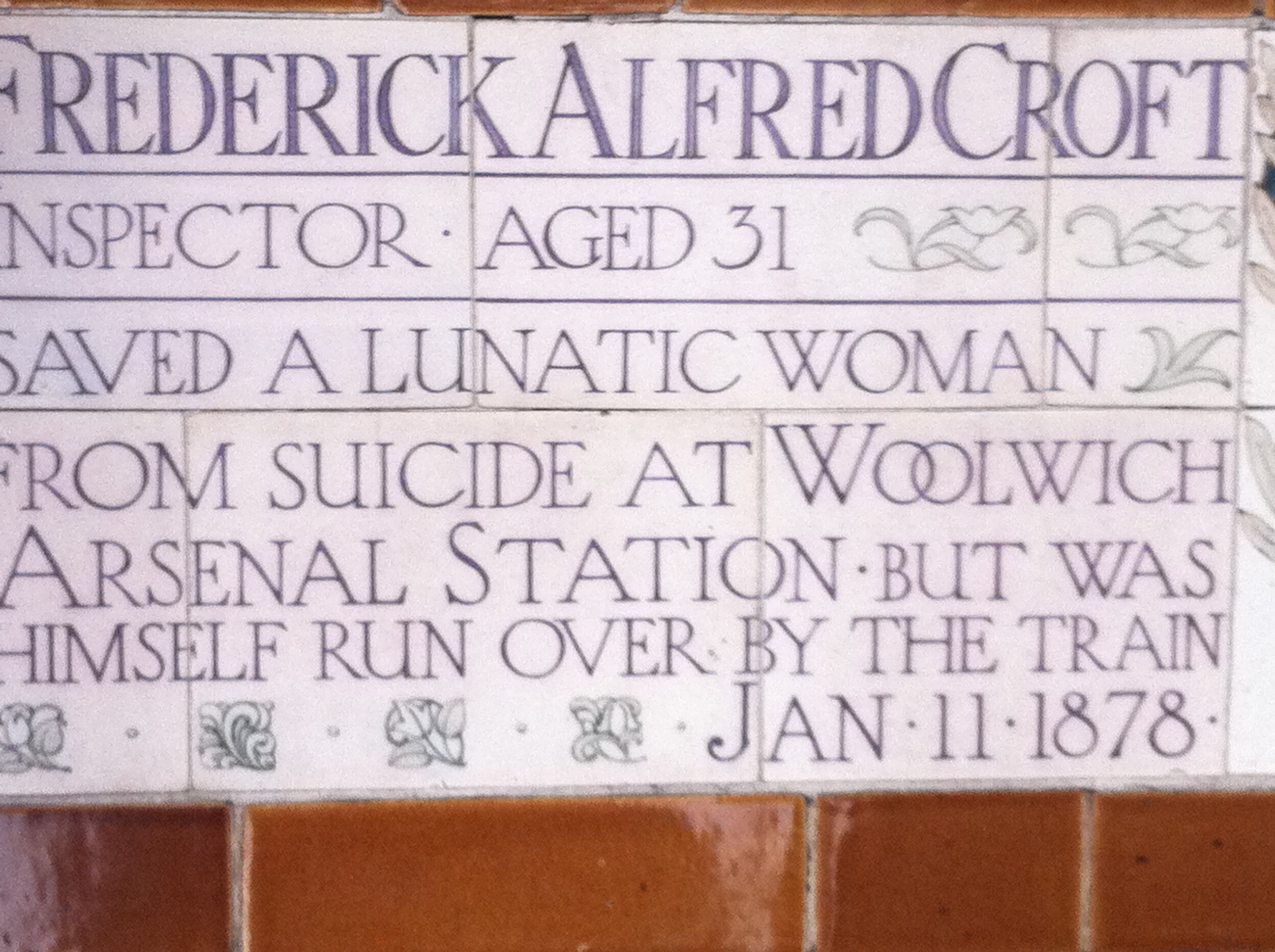
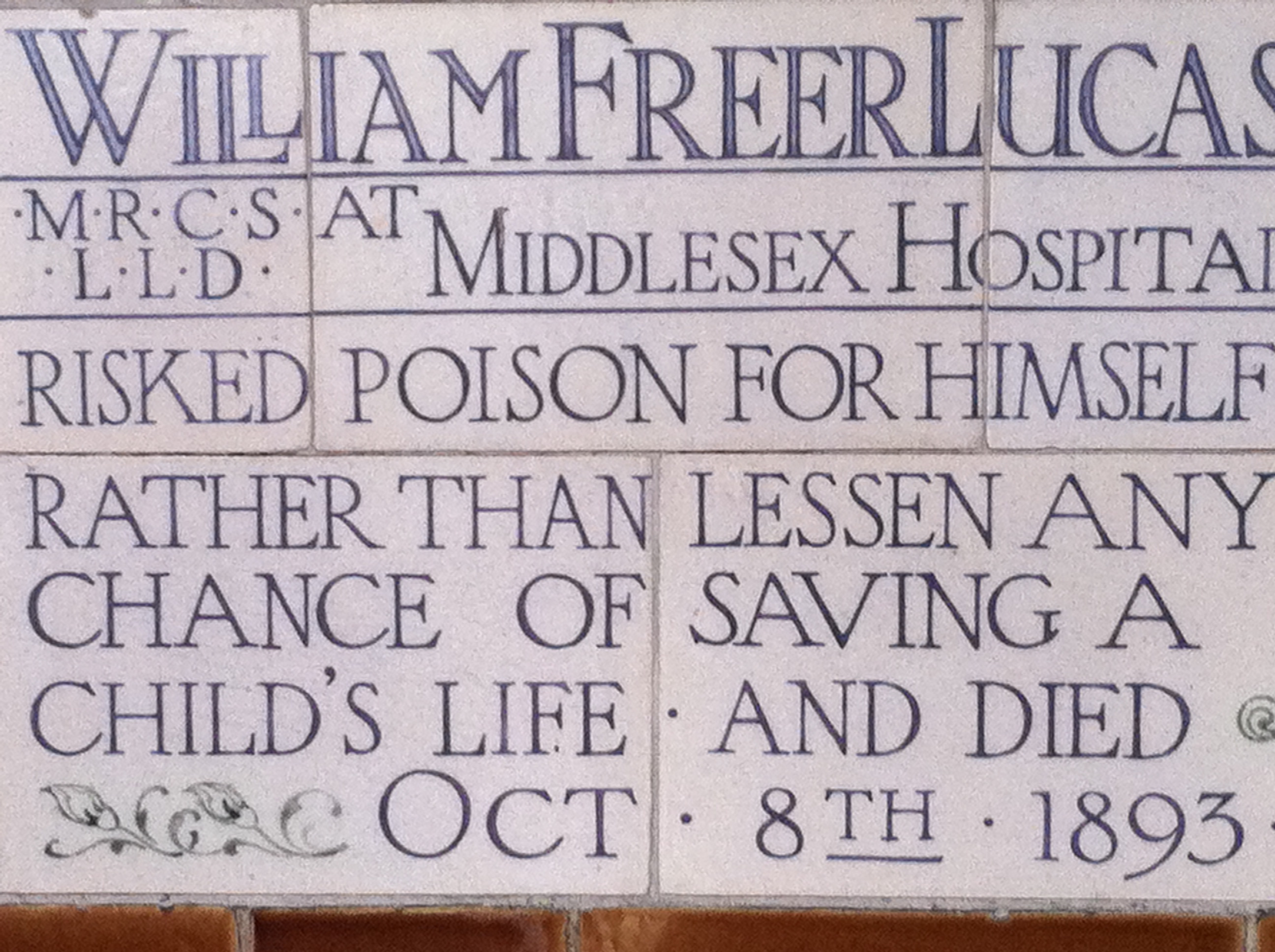
Back at Barts, I am seated in a day ward. There are about eight chairs in a ward, each with a less comfortable guest seat. The chemo chairs are a bit like those the fat people float about on in Wall-E. A nurse then injects a line into my hand through which, over the next couple of hours, anti-sickness medicines, plus three different chemo drugs and a number of flushes are then pumped. One of the drugs looks like this.

I don’t really feel anything as the drugs are going in. Sometimes they are a bit cold.
As the time goes by, I chat to my friend, who does like a day out. Sometimes we talk to other patients and their companions. There is discussion of wigs, of course, all of us saying that we never could tell – which is usually true – and of journeys. Most people have come from miles away – a two and a half hour journey from Brighton, for example. I feel somewhat guilty that I am just three underground stops away. Being wary of hearing too much about what other people are going through, I try to avoid talk of treatments. I really don’t want to hear about anyone who has secondary cancers or whose treatment is not going splendidly. But sometimes you can’t help it. On Friday, I chatted to two women who do have secondary cancers, which was not ideal, but, on the other hand, they were both in their 70s and had been cancer free for fourteen and twenty-six years, the latter of which seems pretty good to me. (I don’t know how a cancer is even a secondary cancer after 26 years but I’m not ready to ask those kind of questions yet.) This is one of the reasons why I need my trusty friend with me. She is very good at telling me not to build my story onto the stories of people I have never met before and know nothing about, which is a massive temptation.
While we chat, the NHS goes about it’s business brilliantly. On Friday, I was offered coffee and biscuits, followed by sandwiches and fruit, plus a volunteer trolley with newspapers and fancy treats. The nurses are amazing. I know this is a horrible cliche but it’s true. The time before, the lovely Finnish nurse spent ten minutes discussing the pros and cons of invading Finland. Who has time for that? Twice the hospital social worker has been round, both times talking to older gentlemen who were living alone and in need of some additional support. I don’t know how well that support gets delivered but, considering something really horrible is happening to everyone in those chairs, there is a gentle, we’ll get through this, atmosphere.
I leave with a bucketful of medication to help with side effects, and afterwards, my pee is red for a while.

I know Disney won't like me using this picture but here we go anyway.
Scars, arms and saying thank you
November 14, 2011 § 3 Comments
I have matching scars under my arms. The first has been there since I was about ten. Clare McMullen and I invented a game where we looked after leaves. We made them beds in match boxes and polished them with milk. We had toys and no reason to be looking after leaves like babies, but still, this was the game. To gather a new leaf, I was climbing on some railings in the forbidden zone at the edge of our playground, when I slipped and the pointed end of the rail went into my arm-pit. There was lots of blood and general hysteria. I remember putting my hand under my arm and feeling a hole. Our headmaster, the perpetually cross Mr Roberts, put me in his VW camper van and drove me to the local hospital, where I was stitched up, given a tetanus jab and provided with an odd string-vest. Mum came to meet me and I got an Orange Maid ice lolly on the way home. For a couple of weeks, I was something of a star at school. I had to stand up in assembly, Mr Roberts using me as an example of what can happen if you break the rules, but that only added to the excitement of the whole incident. My mum received phone calls from other parents who had heard ever more exaggerated and fantastic accounts of the incident: my arm had been severed; the railing had gone right though my arm pit so that I was left dangling. In fact, it was all rather straightforward. I returned a couple of weeks later to have the stitches removed. I think I kept them.
Now I have a scar under my other arm. This is where the surgeon removed some sample lymph nodes during the lumpectomy I had in the summer. Much less fun.
Last week, I went to the Welcome Collection on Euston Road to see Infinitas Gracias: Mexican miracle paintings. This is an exhibition of small paintings, commissioned by families or individuals to thank saints for helping them through bad times, or, as the blurb says: Mexican votives are small paintings, usually executed on tin roof tiles or small plaques, depicting the moment of personal humility when an individual asks a saint for help and is delivered from disaster and sometimes death. The paintings cover all kinds of dramas, from lightning strikes to gunfights, motor accidents to false imprisonment, and, of course, ill-health.
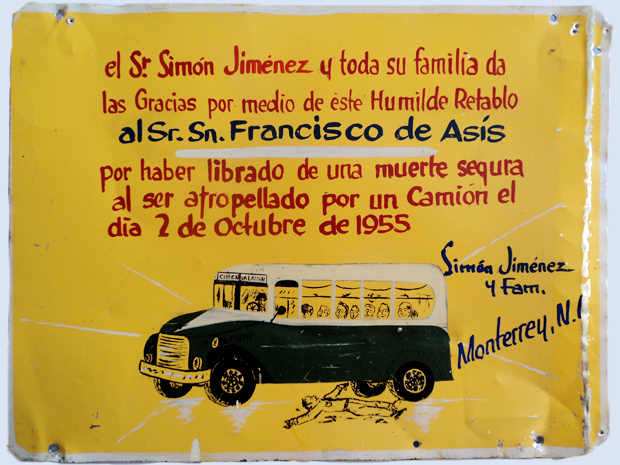
Sr Simón Jiménez and all his family give thanks to Saint Francis of Assisi with this humble retablo for saving him from a certain death after being run over by a bus on 2 October 1955. Simón Jiménez and family. (Monterrey, Nuevo León).
It made me think about being grateful. If I get through all this chemo and surgery and go on to live a reasonably long life, I think I’ll be grateful everyday, although I suppose, as time goes on, I will stop being grateful everyday and just be grateful every other day, such is the way we forget. I hadn’t thought about the leaves and the railings and Mr Robert’s VW van for an age, and I can’t say I’ve ever been conscious of being grateful for that safe delivery.
I know there are quite a few people praying for me and, to be honest, while I am nothing but skeptical about the power of saints or God to save lives, there is a little bit of me, the “whatever it takes” part, which is thankful. The fact that these disasters and illnesses happen in the first place seems so unfair and random that choosing to thank someone equally random for getting you through it, even if it is a long dead man who helped animals, doesn’t seem so odd to me.
A bit too soon to commission my own tile but fingers crossed (ah, see how far I’ve some from similar superstition), I’ll be looking for a willing artist in the not to distant future. And rather than a saint, mine will feature surgeons and breast care nurses and people of science who are even now working their own miracles – well, touch wood, etc.
Take a look at some more of these rather wonderful votive thank yous and I think you will see what I mean.
I didn’t know that happened. Well, now you do. No.1: Sore Tongue
November 4, 2011 § 3 Comments
Without wanting to stray into the area of too much information, I have been told that I need to say more about things that are happening to my body. I’ve avoided this a bit because I don’t want this blog to be a big cancer moan. On the other hand, two people who have been really helpful to me, Gail and Cheryl, are women who have been through chemo themselves and who have been generous in offering reassurance when I send yet another frantic text outlining some new symptom. “Oh yes,” they say. “That happened to me,” and I calm down. As Gail said to me, having chemo gives you a grounding in health issues you never imagined to be relevant.
So the following is offered in the spirit of: 1. I didn’t know that happened, and 2. Well, now you do.
In the previous post I mentioned having thrush on my tongue. The problem with chemo is that it doesn’t know just to attack the bad multiplying cells. Instead, like a child who’s had too many fizzy drinks, it runs rampant, having a go at pretty much anything. In particular, it likes fast growing cells – good, in that we want it to nut any quickly developing bits of cancer, but bad, in that this is what causes your hair to fall out, for example.
Back to my mouth. In case you don’t know, oral thrush is an infection of a yeast fungus called Candida albicans in the mucous membranes of the mouth. It doesn’t become a problem until there’s a change in the chemistry of the oral cavity that favours candida over the other micro-organisms that are present and, wouldn’t you know it, chemo prompts those changes. Bugger. Babies and denture wearing folk are also prone to getting it. The result – an ugly white sludge. It feels as if someone has taken a razor to the top layer of my tongue and then tried to sandpaper the surface. Rather spitefully, that same person has then sprinkled a nasty tasting something on to what remains.
The GP assures me that oral thrush is actually very common and seemed surprised that I hadn’t had it before, so maybe, after all, I have lived a very sheltered life. He had given me an oral suspension, which I have to leave on my tongue several times a day and not talk for a while. Very much hoping this will do the trick.
Other mouth issues can include ulcer like sores, a few of which I had during the first lot of treatment but haven’t had since, and a dry mouth. The lovely Gail told me she was given artificial saliva. Who knew? I also suspect I am drinking way too much orange and grapefruit juice because the sharp flavour cuts through the thrush nastiness, hence storing up a host of teeth issues. Hey ho! One thing at a time.
And, as you know, I like to give you a bit of art. So here is Robert Maplethorpe’s Clothespinned Mouth 1978, from the Tate’s collection. Apparently, it is more about sado-masochistic fetishes, the S&M scene of the 1970s and Mapplethorpe’s strict Catholic upbringing than it is about oral thrush, but it works for me.
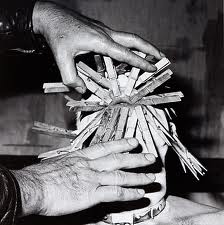
Sore mouth
Thoughts on endurance following a visit to Tate Britain
November 3, 2011 § 4 Comments
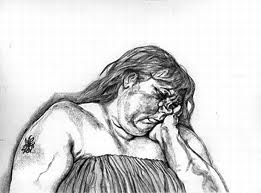
Me, minus tattoo and obviously without hair
This is pretty much how I’ve been feeling for the last week (Woman with an Arm Tattoo, 1996, Lucian Freud). I had my third chemo last Friday and this time has been somewhat rougher, a bit like a poisonous marshmallow has been pumped into my head and is expanding to fill all possible brain space. For several days, I have sat on the sofa for eight straight hours, watching episodes of Poirot and House of Elliot. I have thrush on my tongue, queasy rumbling in my tummy and would wrestle your grandmother to the floor for a whole night’s sleep. (Mr Davies says I have to say it like it is, and not always be, “Oh, yes, it’s not that bad really.” Fair enough.)
But today I am starting to feel better, at bit more like this:
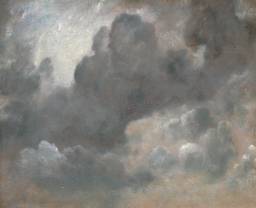
Cloud Study, 1822, John Constable
I had a nice cup of coffee with Mr Fairhurst this morning and discussed the epic saga that is Australian Masterchef. Then I wandered around Tate Britain, dodging school parties, art students and the elderly, the only people in art galleries at ten on a weekday. I recommend the Don McCullin photographs, Mark Wallinger’s Threshold to the Kingdom, and Peter Doig’s Echo Lake. Then I had to have a sit down.
Chemo is a bit like having a baby. You have just enough time to forget how awful it is before they shoot you up again. I assume this is the only way to ensure that anyone comes back for another go. In the words of Harry Venn in the recent BBC drama, Hidden: “There are some things you just have to see through to the end. That’s all you can do.” For sure, this is one of those things and times and while part of me thinks no one has ever had it so bad, I also know that isn’t true. Only this morning, I found myself quoting Harry to Rex300, who would have given anything – ANYTHING – to not have to go swimming with the school today. I don’t think I felt any worse than he did. Rex3000 hates swimming lessons with the kind of immediate dread and passion which I haven’t felt since childhood, until that is, this treatment. He clearly thought I was bonkers, but it is what awful swimming lessons teach us, I suppose. Shouty teachers, shivering at the edge of the pool, and not enough time to do up a top button and tie a tie, all to be endured.
And when we’re all through all this enduring, I’m very hoping it will feel like this:
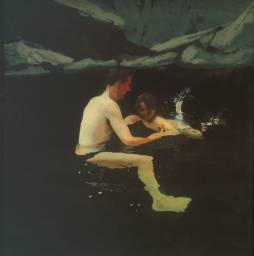
Melanie and Me Swimming, 1978-9, by Michael Andrews
Mr Davies’ Overcoat
October 24, 2011 § 5 Comments
Last week, I was feeling better, so went to see the Degas exhibition at the Royal Academy, followed by the Museum of Everything in the basement at Selfridges, sort of extremes in the exhibition world. I liked them both. For those not familiar with the Museum of Everything, the exhibition is “an initiative to highlight the role of progressive art workshops for artists with developmental disabilities.” There were loads and loads of good things to see, all for a suggested donation of £2.00. I particularly liked the portraits of US presidents (didn’t take down the artist’s name – apologies) and the grappling wrestlers of Tomoyuki Shinki. Unfortunately, this exhibition has now finished but well worth watching out for next year.
Degas and the Ballet was a bit of a surprise to me. I’m not a big fan of dance but went along because a good friend asked me and she has access to the members’ tea room. Came away with a couple of thoughts.
1. The exhibition is pretty interesting. Lots about how Degas’ ballet paintings coincided with the birth of photography and film, both of which he used to examine movement and thus prefect his own work. I didn’t know anything about Étienne-Jules Marey, a Parisian doctor who studied movement both in animals and humans. The exhibition includes some of his great models of birds in flight, like this one.
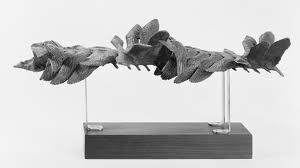
Marey also made films using first his rather spendid photographic gun.

Then, in 1882, he developed a chronophotographic fixed plate camera, equipped with a timed shutter, and finally a camera which used a film strip to record the progress of movement. His films included the falling cat and repeated shots of movement such as this one of a man flexing his arm. All quite lovely and good to see bodies working well.
2. As anticipated, the tea room was nice, although somewhat drew attention to my age – full of ladies of a certain age, generally post retirement, either with husbands or meeting other ladies of a similar certain age. There was general feeling of people having a day out – an exhibition and a bit of lunch, followed by a little light shopping in Fortnum and Mason and a book from Hatchards. And why the heck not? Getting old, going out and about, doing things you enjoy, this is something I want. Being sick doesn’t make me fear old age and its inevitable limitations, but rather fear that I won’t get to be old and experience all that. Perhaps, having had a taste of it, I should worry about being infirm and not as I once was, but in lots of ways I’m already there, certainly the “not as I once was” bit. Surviving enough years to be old, well, that will be living the dream. If I can get through all this rubbish now, I look forward to pointing at pictures with my walking stick and helping an elderly Mr Davies back into his overcoat after a post-exhibition cream tea.
Friends
October 14, 2011 § 2 Comments
One thing I think I have talked about before is how much support I am getting from friends during all this rubbish. You have been outstanding, (as have family, before they start). I’ve been amazed at how considerate people are, and the time they are prepared to give to helping me through all this. All to be hurrahed about. Made me like this picture.

The Two Friends
This is The Two Friends, by Toulouse-Lautrec, painted in 1874 and it’s kind of how I feel. Hugged and and loved. Hoping that in due course that I can be the hugger instead of the huggie for all you lovely folk – although hopefully not in the same circs. You can find this picture in the National Gallery. (And just to say, while it may be a picture of two prostitutes, that doesn’t reflect on any of my friends.)
However, all that is a bit mushy, so here are odder pictures of women together.

Not hugging
According to an inscription on the painting, it shows, ‘Two Ladies of the Cholmondeley Family, Who were born the same day, Married the same day, And brought to Bed the same day’. According to the Tate’s website, “the format echoes tomb sculpture of the period.” All a bit odd, and again with the nightmare, uncomfortable clothes. We don’t know who the artist is but he was probably from Chester, close to where I was brought up. It was painted about 1600. You can see this at Tate Britain.
Even stranger is Gabrielle d’Estrées et une de ses soeurs, again by an unknown artist and from around 1594.

Strange
The picture shows Gabrielle d’Estrées, mistress of King Henry IV of France, sitting up in a bath, while her sister sits beside her and pinches her right nipple. Apparently, this pinching symbolizes Gabrielle’s pregnancy, and is about the milk the breast will produce. I’m quite glad we ladies are no longer celebrating news of a pregnancy in this manner.
I haven’t actually seen this picture – it’s in The Louvre – but it was suggested to me by Liz, one of the friends so praised above.
Masterpieces
October 14, 2011 § Leave a comment
Some famous people have been choosing paintings which they suggest answer the question, what makes a masterpiece? You can see what David Hockney, Phillip Pullman and some art people I don’t know about have selected on the Guardian’s site.
I particularly like what David Hockney says about his choice, Mother and Child, First Steps (1943) by Pablo Picasso and similarly how architect, Amanda Levete, describes her selection, Still Life with Lemons and Oranges (1633) by Francisco de Zurbarán. They both make me go, “Oh yes, now you tell me, I get that too.”
Two things I would note.
1. I am doing my best to ignore art historian, Tim Marlow’s, selection, Hans Holbein’s Dead Christ (1521). I mean, amazing, obviously, but not something I want to contemplate right now.
2. Culture minister, Ed Vaizey, chose The Arnolfini Portrait, which I have previously mentioned on this site – the one where the lady isn’t pregnant, just showing off with lots of cloth. He does point out (in the newspaper, he did anyway) that the faces of the Arnolfinis are almost alien. Rather true, I think. Apparently, he often pops into the National Gallery to see this paintings, so look out for him.
(There may be too many links in this post. This is to show off to my friend, Pamela, that I can do this.)
 anneiskeepingbusy